- Drive 4 wheelers like 4 wheelers and not like 2-wheelers. Most of the RTC buses are driven like 2-wheelers, specially in the Kukatpally route.
- While driving at night use normal headlight mode and not high –beam mode. Guys you need to understand that driving in high-beam mode is dangerous not only for the person who is driving in the opposite direction but also you.
- While crossing roads, use zebra crossing (this is applicable throughout India). In case you are not doing that, atleast develop a sense of understanding the problem driver faces in case you jump right in front of him while attempting to cross the road. Andhra Pradesh is one of the states in India with very high number of road accidents.
- And finally, follow traffic rule, at least the basic ones ( stop at red light, don't race on roads..etc)
Sunday, February 08, 2009
Road skills Hyderabadi must have


Friday, February 06, 2009
Thursday, February 05, 2009
Powerpoint - best practice by Guy Kawasaki
Guy Kawasaki' n addition to being a good author/blogger, was one of the very early Apple employees and more recently has been a venture investor. At Garage (http://www.garage.com/), probably he has seen countless Powerpoint presentations. Presumably because he is tired of seeing poor Powerpoint presentations, he spends many pages in his book, Art of The Start talking about Powerpoint best practices.
His mantra is that Powerpoint should follow a 10/20/30 Rule (check out The Art of Pitching section in the book). There should be no more than 10 slides in the presentation as very few people take away much more than one concept from a presentation, so all that other stuff is extra. The slide presentation should be designed to last 20 minutes, leaving room for ample questions between slides or after the presentation. He says the font should be size should be no smaller than 30 (Arial font). Guy says that audiences read faster than you can talk, so that while you are up there talking, they are trying to read your slides and not listening to what you are saying.
He says that there are something like 60 animation features within Powerpoint and he recommends the less use of it the better. His advice is to use your voice & body to emphasize when a point is important, not some fancy Powerpoint trick. The only place he recommends using any of this is in going through bullet points on a slide, presumably to avoid having people read ahead. Speaking of bullets, Guy suggests that bulleted slides should have one point with bullets and only one layer of bullets (lest you violate the 30 part of 10/20/30).
Guy Kawasaki' n addition to being a good author/blogger, was one of the very early Apple employees and more recently has been a venture investor. At Garage (http://www.garage.com/), probably he has seen countless Powerpoint presentations. Presumably because he is tired of seeing poor Powerpoint presentations, he spends many pages in his book, Art of The Start talking about Powerpoint best practices.
His mantra is that Powerpoint should follow a 10/20/30 Rule (check out The Art of Pitching section in the book). There should be no more than 10 slides in the presentation as very few people take away much more than one concept from a presentation, so all that other stuff is extra. The slide presentation should be designed to last 20 minutes, leaving room for ample questions between slides or after the presentation. He says the font should be size should be no smaller than 30 (Arial font). Guy says that audiences read faster than you can talk, so that while you are up there talking, they are trying to read your slides and not listening to what you are saying.
He says that there are something like 60 animation features within Powerpoint and he recommends the less use of it the better. His advice is to use your voice & body to emphasize when a point is important, not some fancy Powerpoint trick. The only place he recommends using any of this is in going through bullet points on a slide, presumably to avoid having people read ahead. Speaking of bullets, Guy suggests that bulleted slides should have one point with bullets and only one layer of bullets (lest you violate the 30 part of 10/20/30).
Wednesday, February 04, 2009
Monday, January 26, 2009
Warangal Trip


Last Saturday we planned for one day Warangal Trip from Hyderabad. The route we choosed was Bhongir Fort, Yadagirigutta, Kolanpaka, Warangal, Palampet and back. The driver was horrible, had no idea about the route and couldn't speak Hindi. So, we kept asking local people as we travelled.
The first stop was Simhadri temple near Yadagirigutta. After darshan we drove to Yadagirigutta Temple. Yadagirigutta is a popular of Narasimha
Swamy situated on a hillock. Yadagirigutta is about 60km from Hyderabad.
In Tretayugam, there lived a sage by the name of Yadarishi, son of the great sage Rishyasrunga and Santa Devi who did penance inside a cave with the blessings of Anjaneya (Hanuman) on this hill between Bhongir (Bhuvanagiri) and Raigiri (Now in Nalgonda district of Andhra Pradesh). Pleased with his deep devotion, Lord Narasimha, an incarnation of Lord Vishnu appeared before him in five different forms as Jwala, Yogananda, Gandabherunda, Ugra and Lakshminarasimha. They later manifested themselves into finely sculpted forms that later came to be worshiped as Pancha Narasimha Kshetram.
There are Purana and traditional accounts of this Shrine, which are widely popular among the devotees. There is mention about the origin of this temple in the Skanda Purana, one of the famous 18 puranas.
Glowing bright atop the sikharam of garbha griha (Sanctum Sanctorum) of this cave temple is the golden Sudarshana Chakra (about 3 ft x 3ft) of Lord Vishnu (whose reincarnation is Lord Narasimha), the adornment as well as the weapon is a symbol this temple is identified by from as far away as 6 km. It is said that many years ago the chakra moved in the direction from which the devotees came as if like a compass guiding them towards the temple.
Lord Narasimha is believed to have been worshiped by sages (rishis). The region of Yadagirigutta is reputed to be a "Rishi Aradhana Kshetram" or the place of worship for sages.
As the belief goes, Lord Narasimha has taken on the role of a "doctor" and is known as "Vaidya Narasimha" by his devotees at this shrine to cure many chronic diseases and the role of a 'do gooder' to those who are under the influence of bad planets, witch craft and black magic. Many instances are cited of the Lord appearing in the dreams of the devotees, and administering medicines and operated the patients and blessed them with good health. Many devotees tell of vivid dreams in which the Lord comes to heal them from chronic or terminal illnesses, and even mental or emotional problems. A mandala (40 day) pradakshina is very popular made by many devotees to get cured of a long standing ailment or chronic disease. Often, the Lord Himself has imparted mantrOpadEsham to select devotees in their dreams.
Another Legend also has it that Sriman Narayana, pleased with Yada's penance, sent Sri Anjaneya to direct the rishi to a holy spot, where the Lord appeared to him in the form of Sri
LakshmiNarasimha. This spot is marked by a temple located at the foot of the Yadagiri hillock, and is located about 5 km from the present temple. There the sage worshiped the Lord for many years.
After Yadarishi attained moksha, a number of tribals, hearing of the Lord's presence, came to worship Him at this temple. But, not being very learned, these devotees began to engage in improper worship. Because of this, Sri LakshmiNarasimha moved into to the hills. The tribals searched for many years to find their Lord, to no avail.
After many years had passed, the Lord appeared in the dream of a devout lady among the tribe, directing her to a large cavern wherein He revealed Himself to all as five majestic Avatars.
The Aradhanam and Puja in this temple are performed according to Pancharatra Agamam. The puja vidhanam (Puja procedure) was set by Late Sri Vangeepuram Narasimhacharyulu who composed Yadagiri Suprabhatam, Prapatti, Stotram, Mangalashasanam and served as Sthanacharya of this temple.
It took around 2 hrs for darshan. After darshan we drove straight to Warangal. For more information on Yadagirigutta temple visit http://www.yadagirigutta.in/
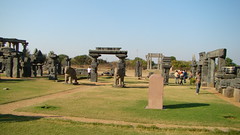
The first stop was 1000 pillar temple. This temple is one of the finest examples of Kakatiya architecture and a testimony to the Vishwakarma Brahmin's excellence in sculpture. Built by Rudra Deva built in 1163 in the style of Chalukyan temple art, it is star shaped and triple shrined.
Image 2: Nandi bull at 1000 pillar temple
Recently, when the archeological department was conducting excavations, they found a water well below the kalyanamandapam, which leads to the conclusion that the foundation of this wonderful structure was built on water.
The marvelous structure was destroyed by the invaders. The temple had idols of 3 Gods, Shiva, Surya and Vishnu. The invaders stole Surya and Vishnu idols. The Shiva idol is still there. And people workship Shiva in the temple. The ASI needs to be more proactive in keeping the structure. Locals charge Rs 20 for parking the car, where as there is no entry fee to enter the site.
From 1000 pillar temple we drove to Bhadra Kali temple. Situated on a hilltop between Hanamakonda and Warangal, it is noted for its stone image of the Goddess Kali. The temple is located on the banks of the "Bhadrakali" Cheruvu (lake).
Our next destination was Warangal Fort or Kila Warangal.
You need to drive through the bazaar and cross the railway line. The fort is approximately 2 km from the station. Warangal fort dates back to the 12th and 13th century.
Image 3:
Remains of Fort Warangal
The fort was mostly destroyed by invaders and only the ruins can now be seen. The fort had three protective walls, remnants of which can still be seen today. The first is a mud wall that stands today up to about 20 feet high and several kilometers in circumference, encircling the fort. The second is a wall made of granite rock. The fort has four famous stone gateways, about 30 feet high and still standing, a masterpiece carved from a single rock. They are called Kirti Toranas (gateways of glory) of the Kakatiyas. Another masterpiece from the Kakatiyas. Something else was waiting for me. The Ramappa Temple.
Ramappa Temple also known as Ramalingeswara Temple, is situated in Palampet village, 70 km from Warangal. This is a beautiful monument dating back to 1213 A.D. It displays the glory and richness of the Kakatiya kingdom and is one of the finest specimens of Hindu temple architecture of the time. This medieval temple is a Shivalaya and named after the sculptor Ramappa, a Vishwakarma Brahmin Sthapathi of Karnataka State, who built it rather that after its presiding deity, Ramalingeswara, perhaps to accent Shiva's importance as the personal god of the avatar of Vishnu, Rama. The history says that it was taken 40 years to built this temple.
Image 4: Ramappa Temple
This beautiful temple, an example of brilliant Kakatiya dynasty art, planned and sculpted by Vishwakarma Brahmin Sthapathis was built on the classical pattern of being lifted above the world on a high star-shaped platform. Intricate carvings line the walls and cover the pillars and ceilings. Starting at its base to its wall panels, pillars and ceiling are sculpted figures drawn from Hindu mythology. The roof of the temple is built with bricks, which are so light that they are able to float on water.
The hall in front of the sanctum is filled with exquisitely carved pillars that are placed as to combine light and space wonderfully with the finely chiselled walls and ceiling. There are two small Shiva shrines on either side of the main temple that are completely ruined. The enormous Nandi within, facing the shrine of Shiva, remains in good condition. In most of the shiva temples, the Nandi was strait to deity but in the temples built by Kakatiyas the Nandi is in a alert position and waiting for the order of lord Shiva.
For more images visit my site on Flickr http://www.flickr.com/photos/anandarup/
Sunday, December 21, 2008

Tuesday, December 09, 2008


Thursday, October 09, 2008
Monday, August 25, 2008
Metrics vs. Matrix
The words Metrics and Matrix cause confusion, as they sound similar. So, what’s the difference between them?
Metrics:
Metric is a measurement.
Product Quality Metrics describe the characteristics (i.e. Size, complexity, performance Quality level of the product). For example:
- Mean time to failure
- Defect density
- Customer Problems
- Customer Satisfaction
- Defect Removal Efficiency
Matrix:
Matrix is a data representation and data collection mechanism. Then we use collected data to derive metrics. For example:
- Requirements Traceability Matrix
- Functional Traceability Matrix
- Test Matrix
Sunday, August 10, 2008


Friday, July 25, 2008
Sunday, July 13, 2008
Golconda Fort (through some pictures)


To check out more fort pictures visit http://www.flickr.com/photos/anandarup/


To check out more fort pictures visit http://www.flickr.com/photos/anandarup/
Friday, June 27, 2008
Friday, June 20, 2008
Wednesday, June 04, 2008
Petrol is cheaper
Petrol is cheaper than the Coca Cola you drink. It is not just petrol; most liquids that you daily use are more expensive than vehicle fuels. Here are the latest figures to compare.
Diesel (regular) in Mumbai : Rs.39.08 per litre
Petrol (speed) in Mumbai : Rs.57 per litre
Coca Cola 330 ml can : Rs.20 = Rs.61 per litre
Dettol antiseptic 100 ml Rs.20 = Rs.200 per litre
Radiator coolant 500 ml Rs.160 = Rs.320 per litre
Pantene conditioner 400 ml Rs..165 = Rs.413 per litre
Medicinal mouthwash like Listerine 100 ml Rs.45 = Rs. 450 per litre
Red Bull 150 ml can : Rs.75 = Rs.500 per litre
Corex cough syrup 100 ml Rs.57 = Rs. 570 per litre
Evian water 500 ml Rs. 330 = Rs. 660 per litre. Rs. 500 for a litre of WATER???!!! And the buyers don't even know the source (Evian spelled backwards is Naive.)
Kores whiteout 15 ml Rs. 15 = Rs. 1000 per litre
Cup of coffee at any decent business hotel 150 ml Rs. 175 = Rs. 1167 per litre
Old Spice after shave lotion 100 ml Rs. 175 = Rs. 1750 per litre
Pure almond oil 25 ml Rs. 68 = Rs. 2720 per litre
And this is the REAL KICKER...
HP Deskjet colour ink cartridge 21 ml Rs.1900 = Rs. 90476 per litre!!!
Petrol is cheaper than the Coca Cola you drink. It is not just petrol; most liquids that you daily use are more expensive than vehicle fuels. Here are the latest figures to compare.
Diesel (regular) in Mumbai : Rs.39.08 per litre
Petrol (speed) in Mumbai : Rs.57 per litre
Coca Cola 330 ml can : Rs.20 = Rs.61 per litre
Dettol antiseptic 100 ml Rs.20 = Rs.200 per litre
Radiator coolant 500 ml Rs.160 = Rs.320 per litre
Pantene conditioner 400 ml Rs..165 = Rs.413 per litre
Medicinal mouthwash like Listerine 100 ml Rs.45 = Rs. 450 per litre
Red Bull 150 ml can : Rs.75 = Rs.500 per litre
Corex cough syrup 100 ml Rs.57 = Rs. 570 per litre
Evian water 500 ml Rs. 330 = Rs. 660 per litre. Rs. 500 for a litre of WATER???!!! And the buyers don't even know the source (Evian spelled backwards is Naive.)
Kores whiteout 15 ml Rs. 15 = Rs. 1000 per litre
Cup of coffee at any decent business hotel 150 ml Rs. 175 = Rs. 1167 per litre
Old Spice after shave lotion 100 ml Rs. 175 = Rs. 1750 per litre
Pure almond oil 25 ml Rs. 68 = Rs. 2720 per litre
And this is the REAL KICKER...
HP Deskjet colour ink cartridge 21 ml Rs.1900 = Rs. 90476 per litre!!!


Subscribe to:
Posts (Atom)